Global and regional trends and drivers of fire under climate change
Matthew W. Jones, John T. Abatzoglou, Sander Veraverbeke, Niels Andela, Gitta Lasslop, Matthias Forkel, Adam J. P. Smith, Chantelle Burton, Richard A. Betts, Guido R. van der Werf, Stephen Sitch, Josep G. Canadell, Cristina Santín, Crystal Kolden, Stefan H. Doerr, Corinne Le Quéré
Read our article in Reviews of Geophysics (2022)
Introduction
New research highlights how the risk of wildfire is rising globally due to climate change – but also, how human actions and policies can play a critical role in regulating regional impacts.
The study, conducted by an international team of researchers led by the University of East Anglia (UEA) in the UK, shows that anthropogenic climate change is a ‘push’ factor for wildfire potential globally.
Fire weather – the hot dry conditions conducive to wildfires – is increasing under climate change, raising the risk of large wildfires by making landscapes more susceptible to burn more often and more severely. The impacts of climate change on fire risk are predicted to escalate in future, with each added degree bringing enhanced wildfire risk.
The article explores the relationship between fire trends – past, present and future – and a range of controls on fire activity, including climate but also human activity, land use and changing vegetation productivity, which have with important impacts on the ignition of wildfires and their spread across landscapes.
The study reviewed 500 previous research papers and carries out a re-analysis of state-of-the-art datasets from satellite observations and models. It includes analyses of trends in fire weather and burned area for world regions covering all countries, continental-scale macroregions, and key regional ecosystems for fire activity or impact.
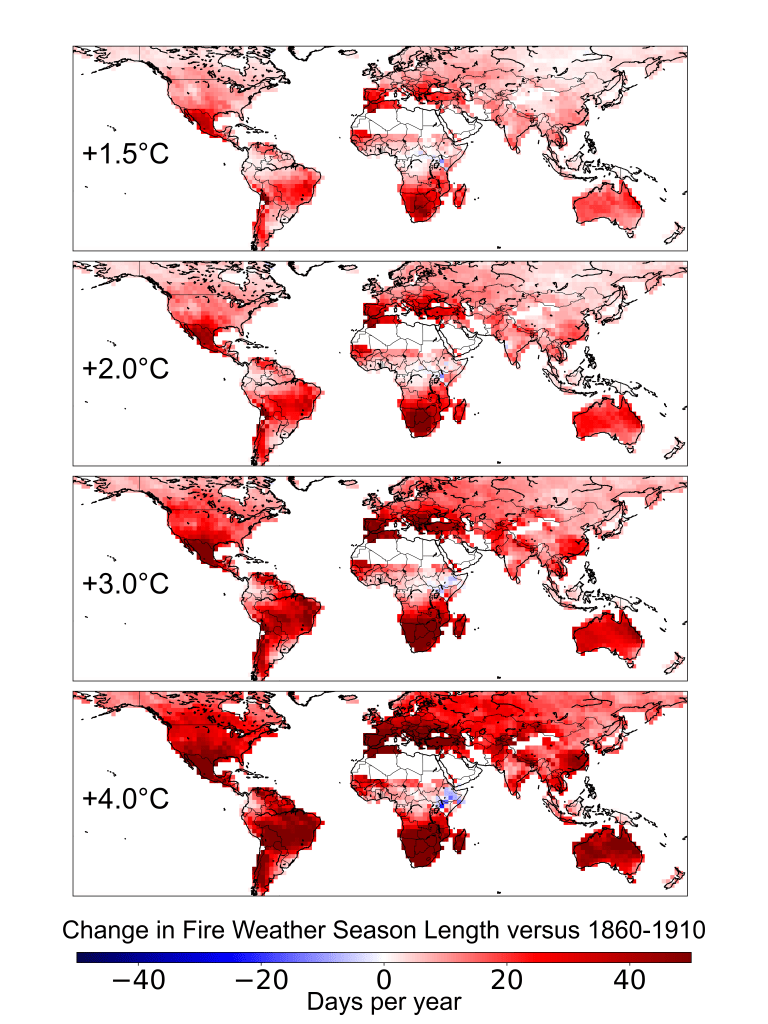
For these same regions, future changes in fire weather are examined at policy-relevant warming increments of 1.5°C, 2°C, 3°C and 4°C, providing insight into how the success or failure of climate policies correspond to the risks of wildfire we will need to live with in future.
Climate Change brings Increased Potential for Fires
The climate models suggest that in some world regions, for example the Mediterranean and Amazonia, the frequency of fire weather conditions in the modern period is unprecedented compared with the recent historic climate, due to human induced global warming of around 1.1°C.
More importantly, this will be the case in virtually all world regions if global temperatures reach 2-3°C of warming as per the current trajectory.
Climate models have also shown that the likelihood of some of the most recent and catastrophic wildfires in the western US, Australia and Canada has been significantly greater due to historical climate change.
Visualising the Regional Impacts of Climate Change on Fire Potential
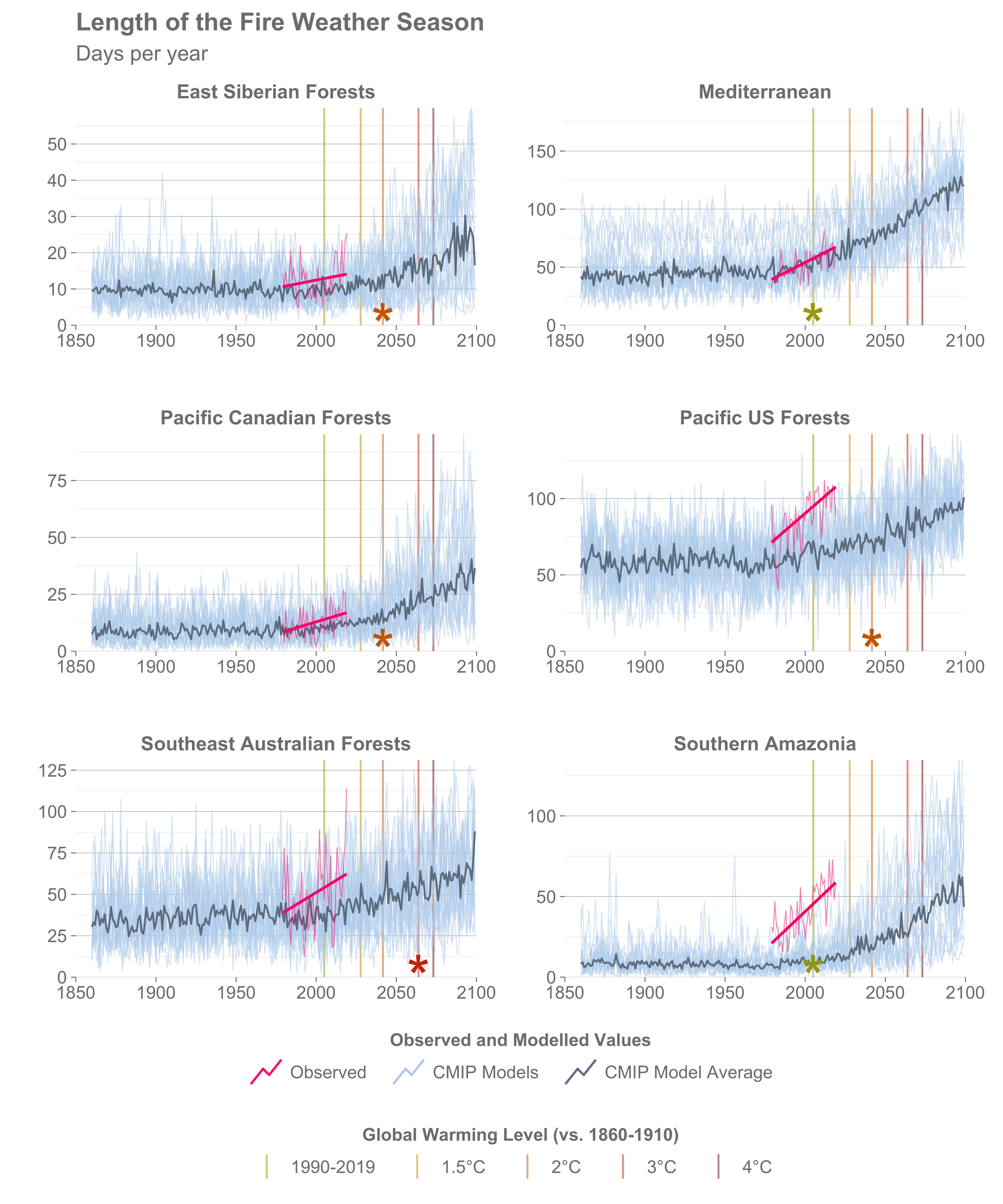
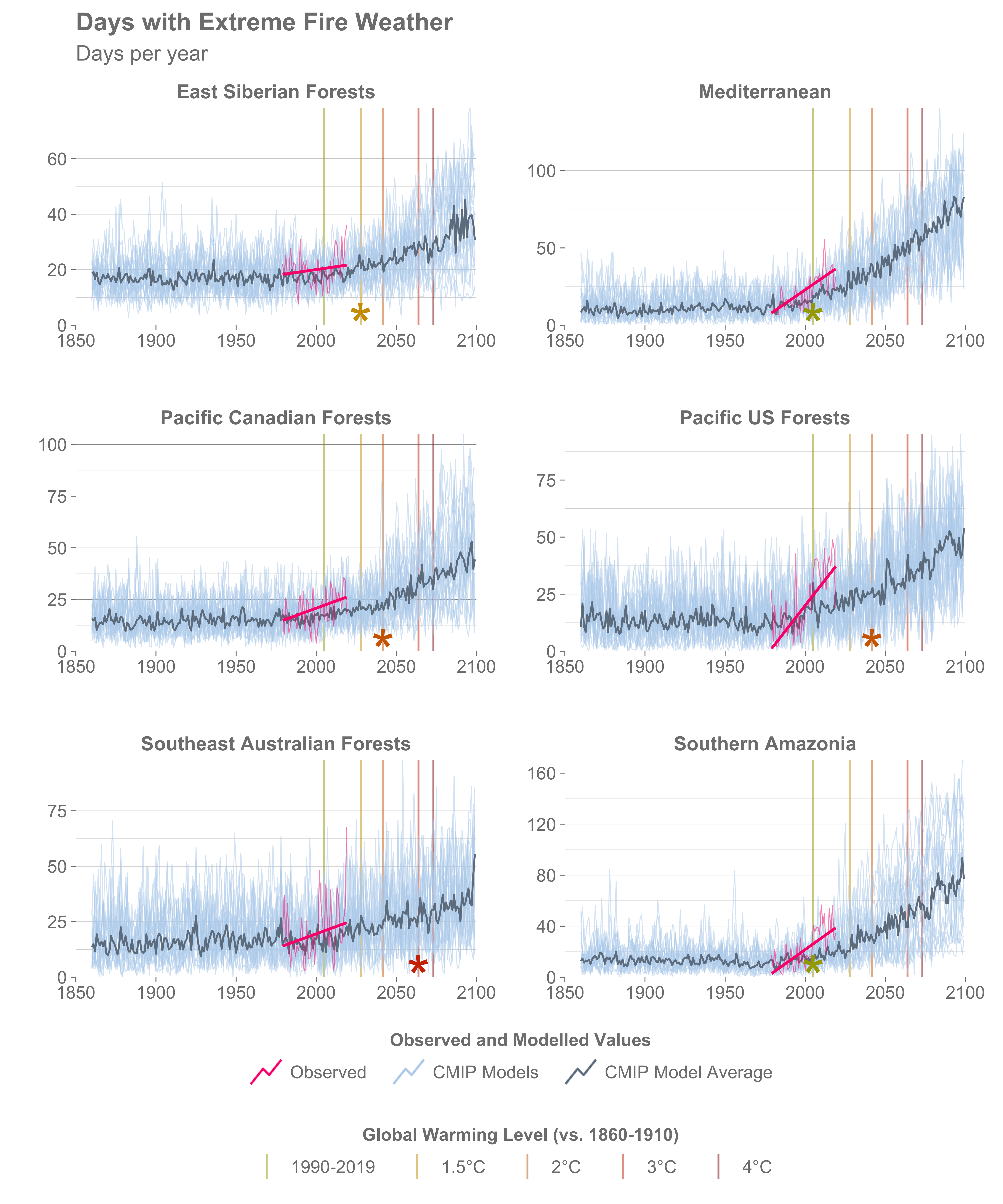
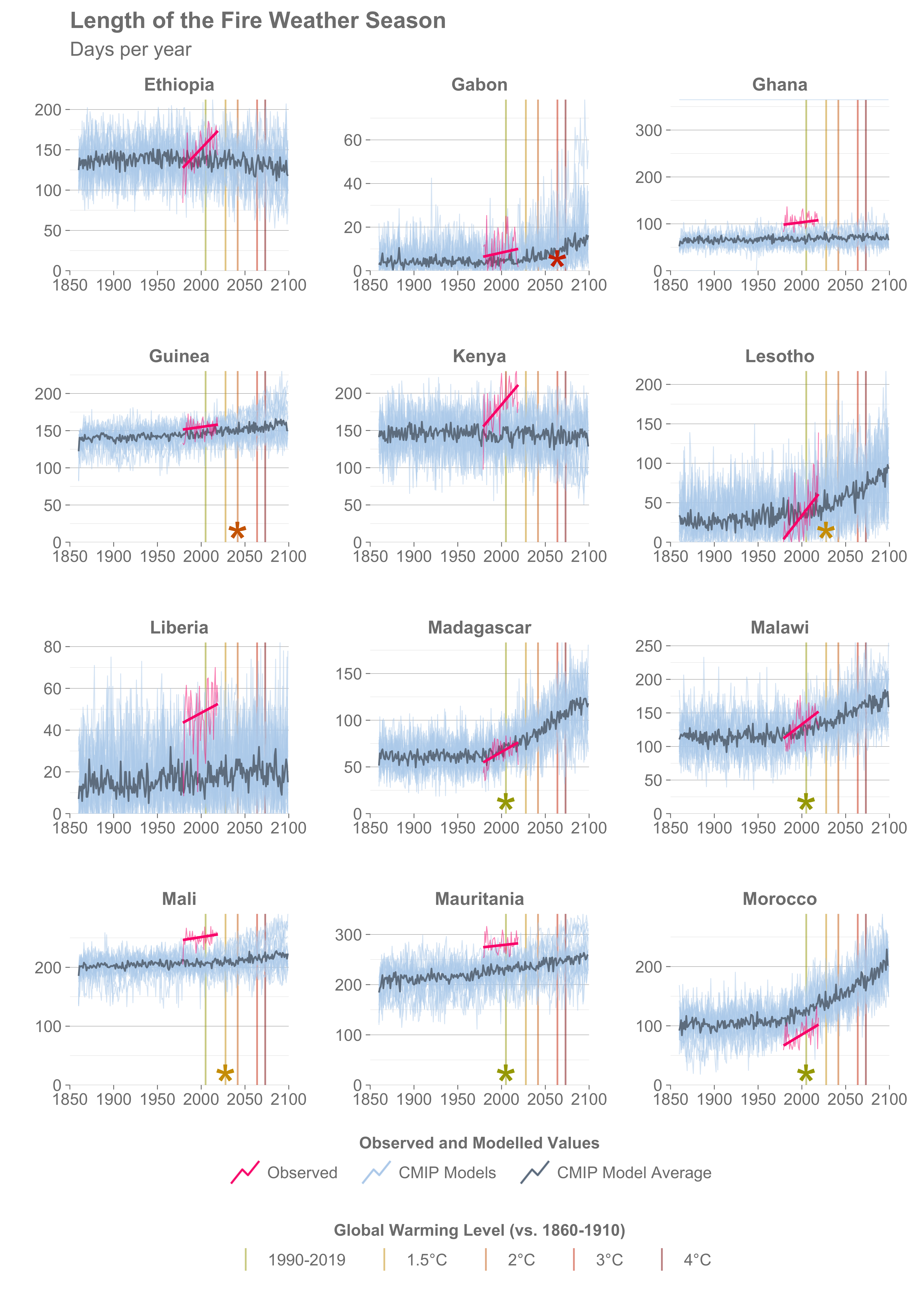
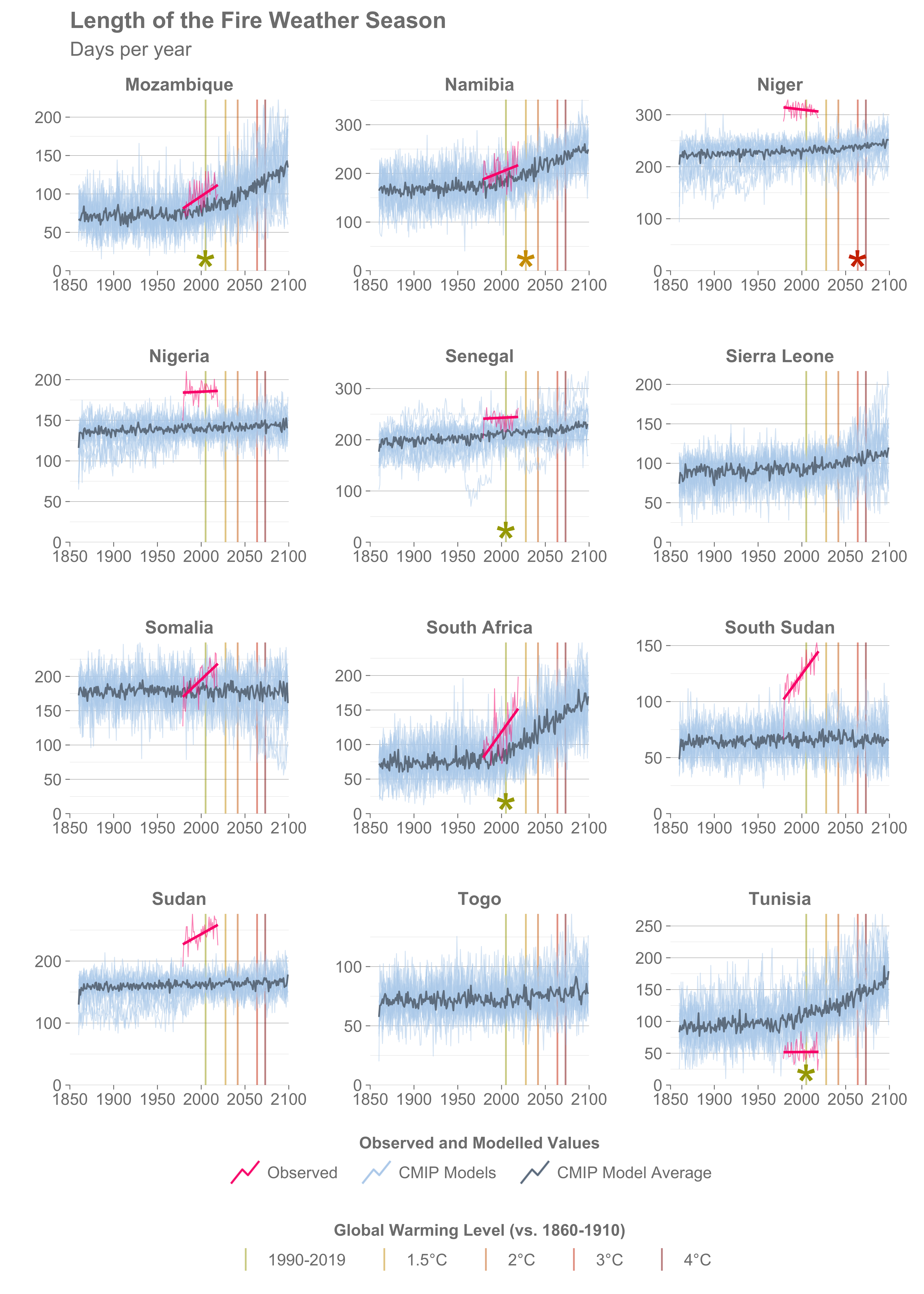
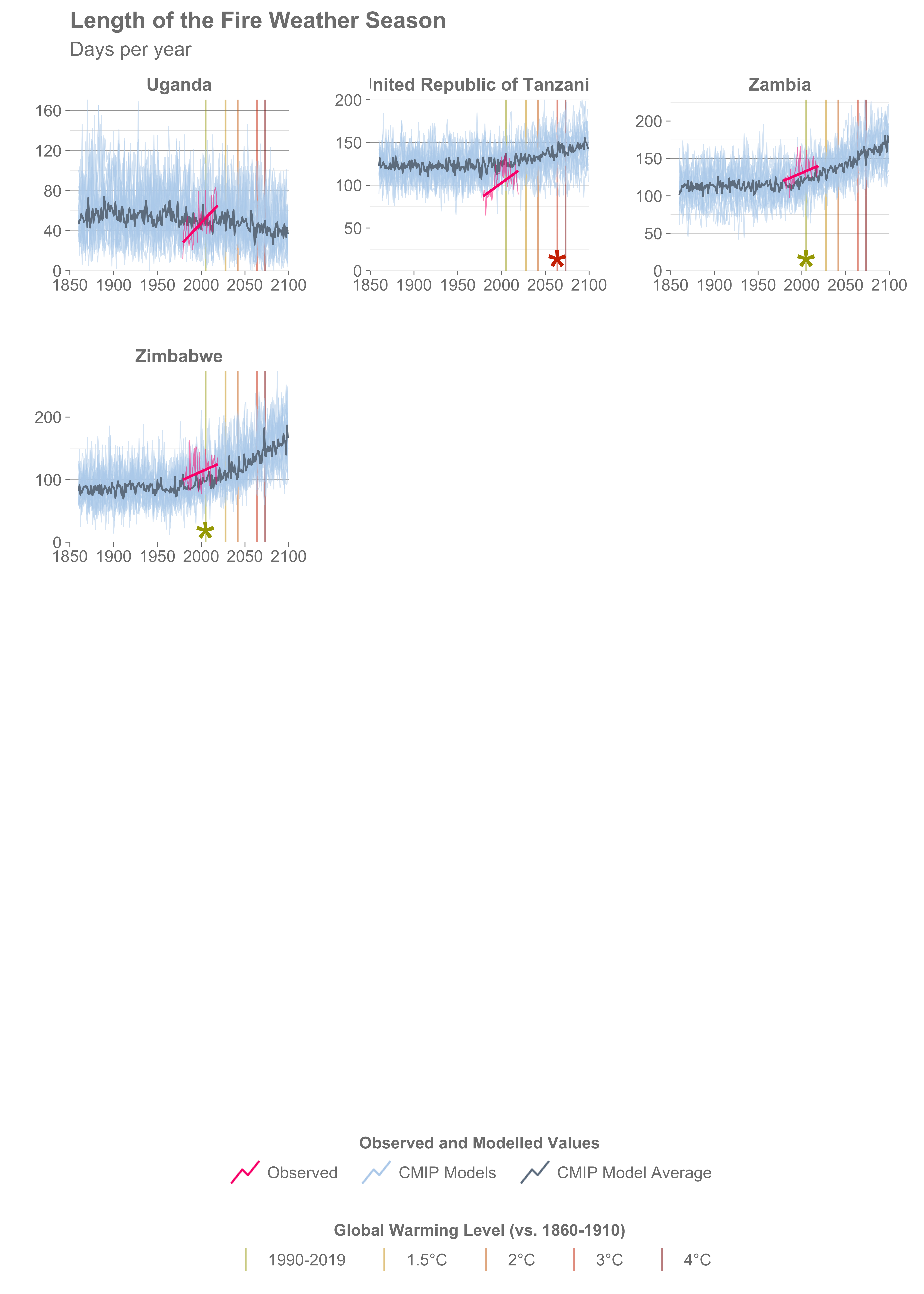
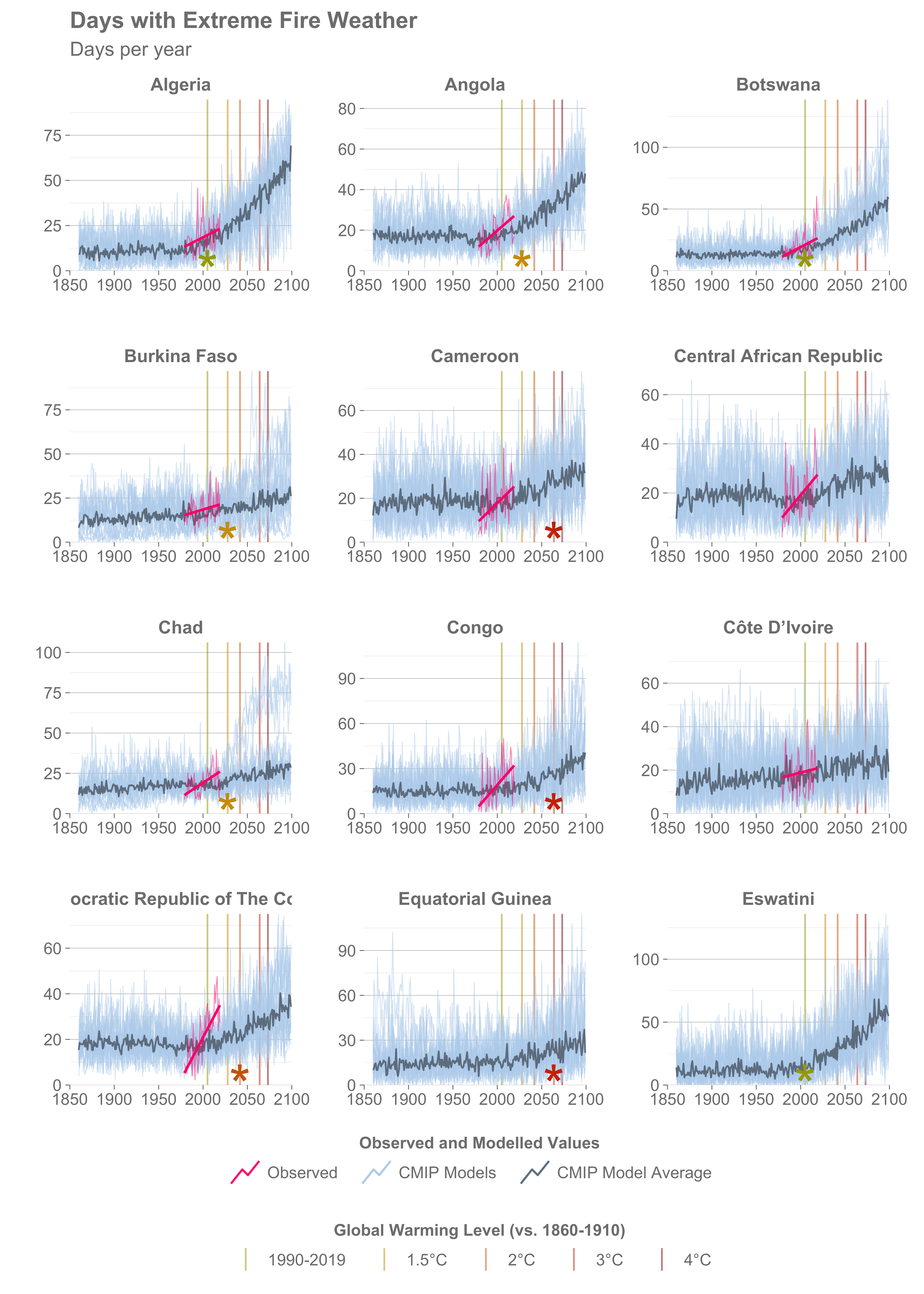
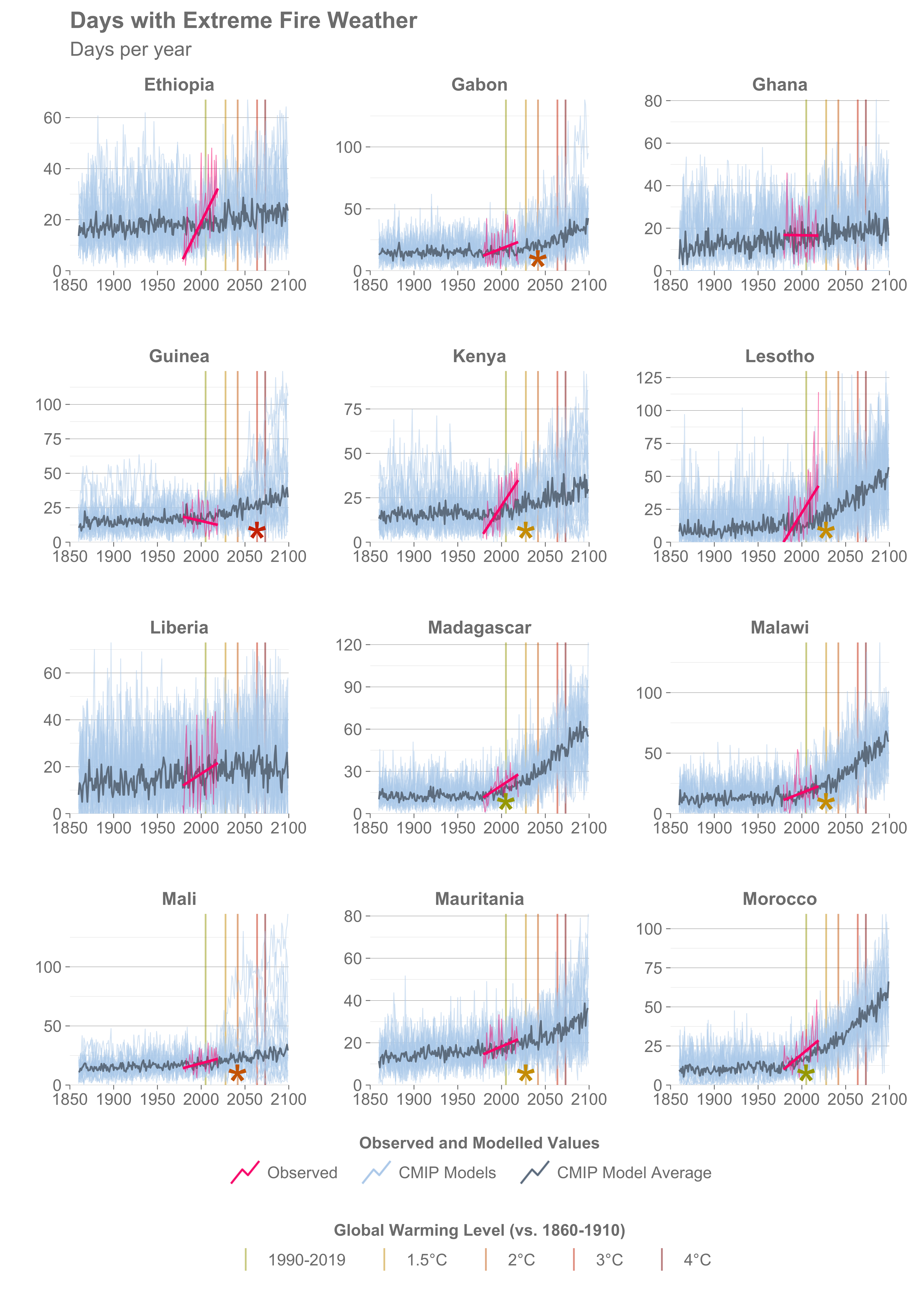
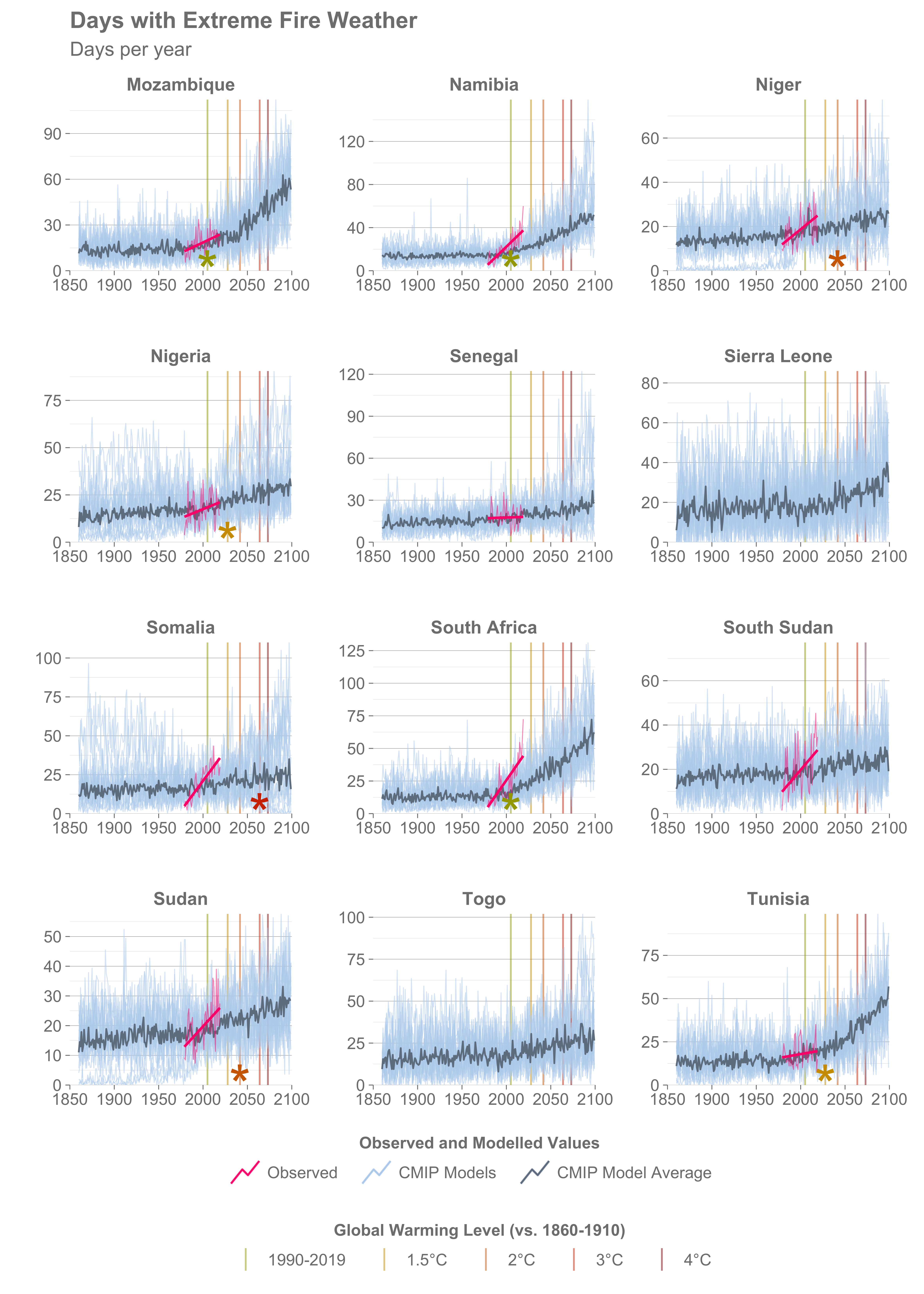
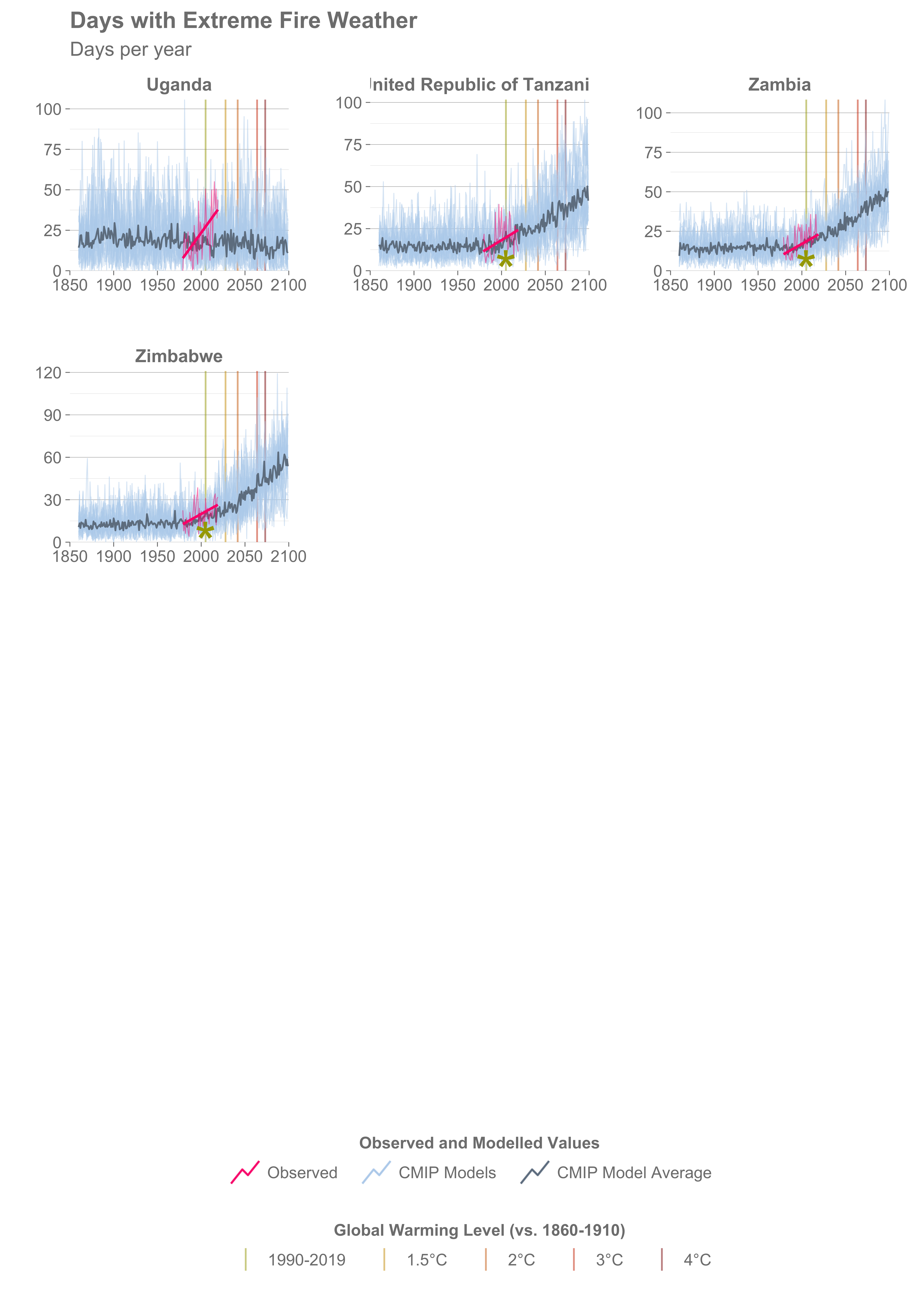
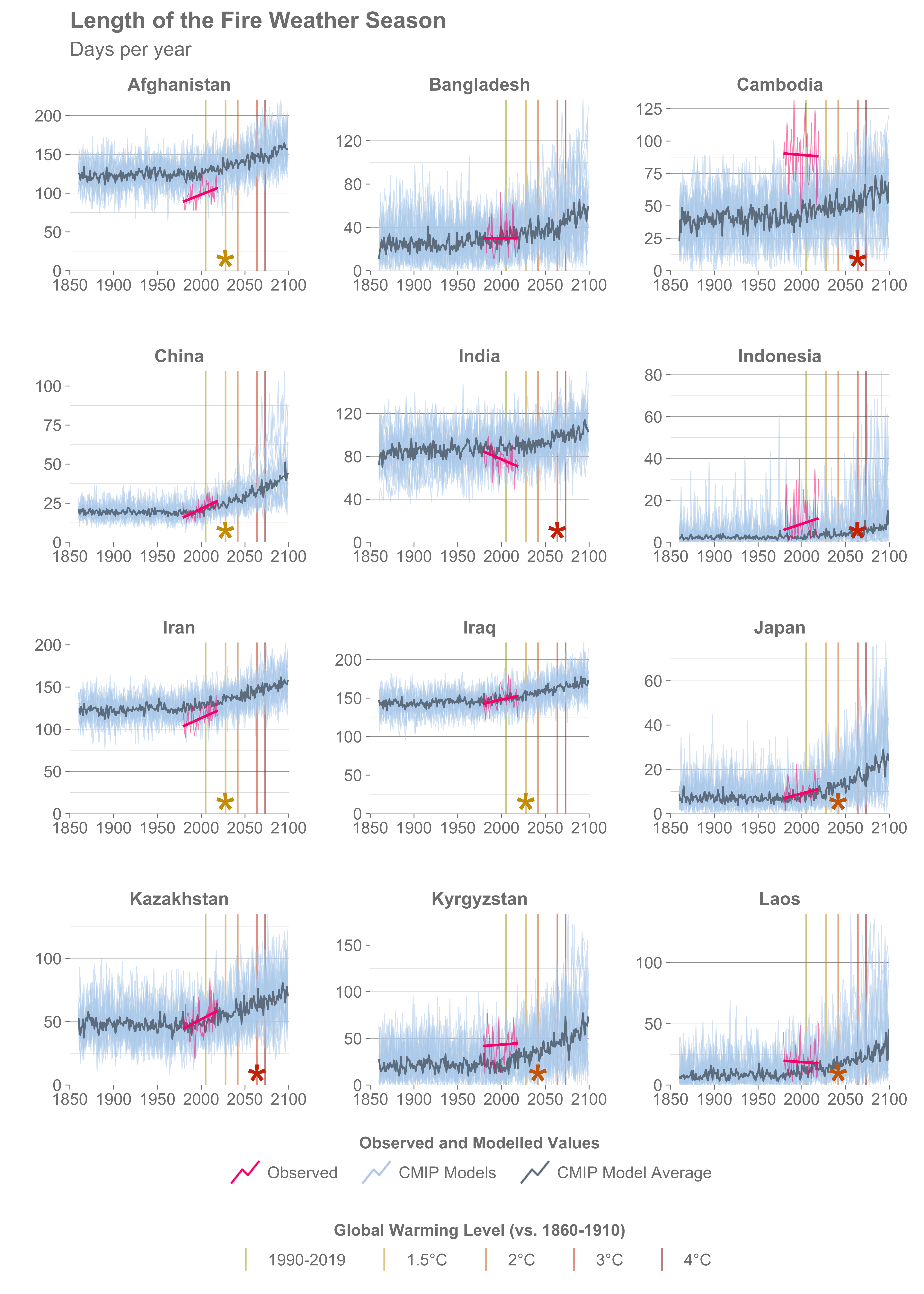
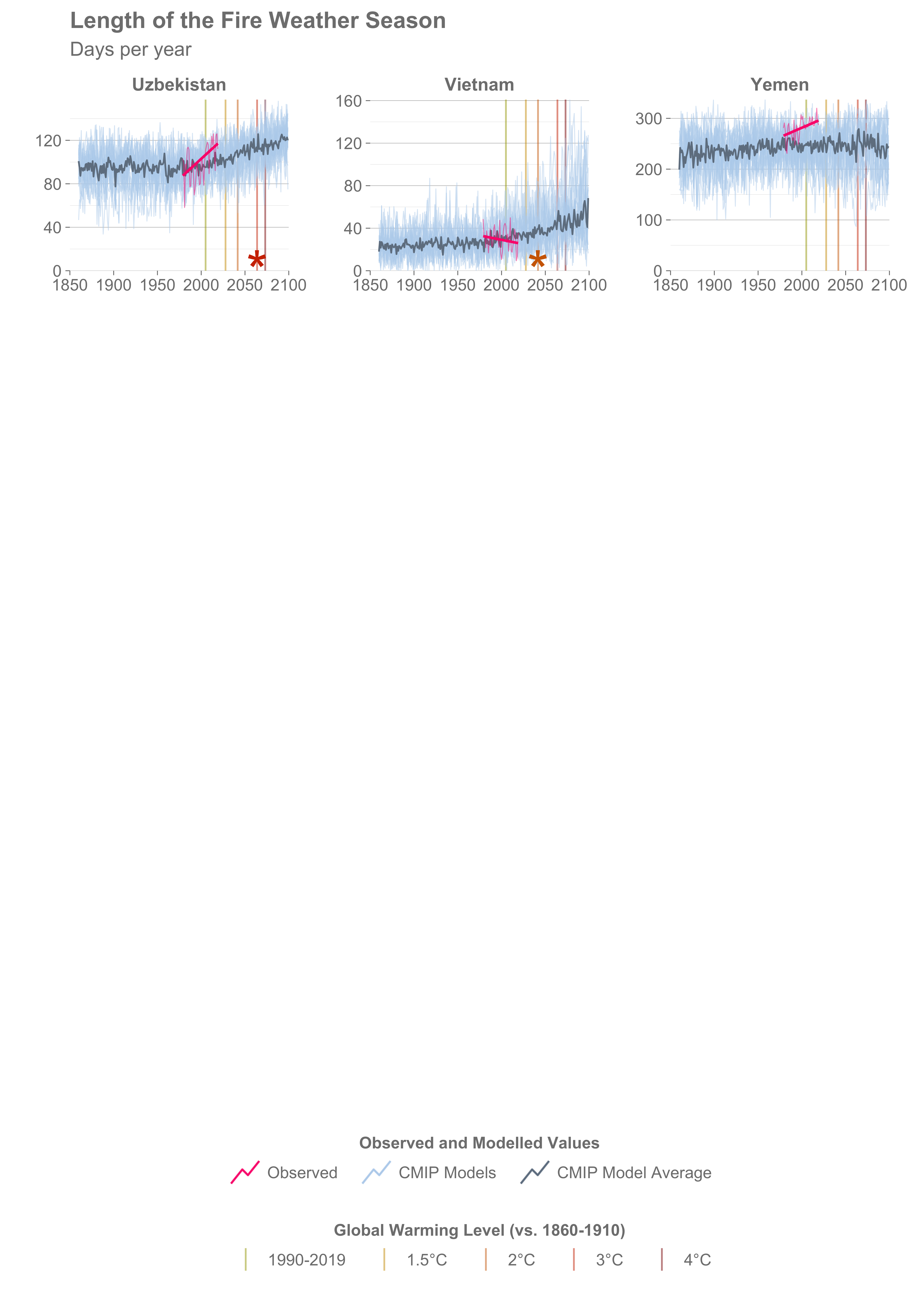
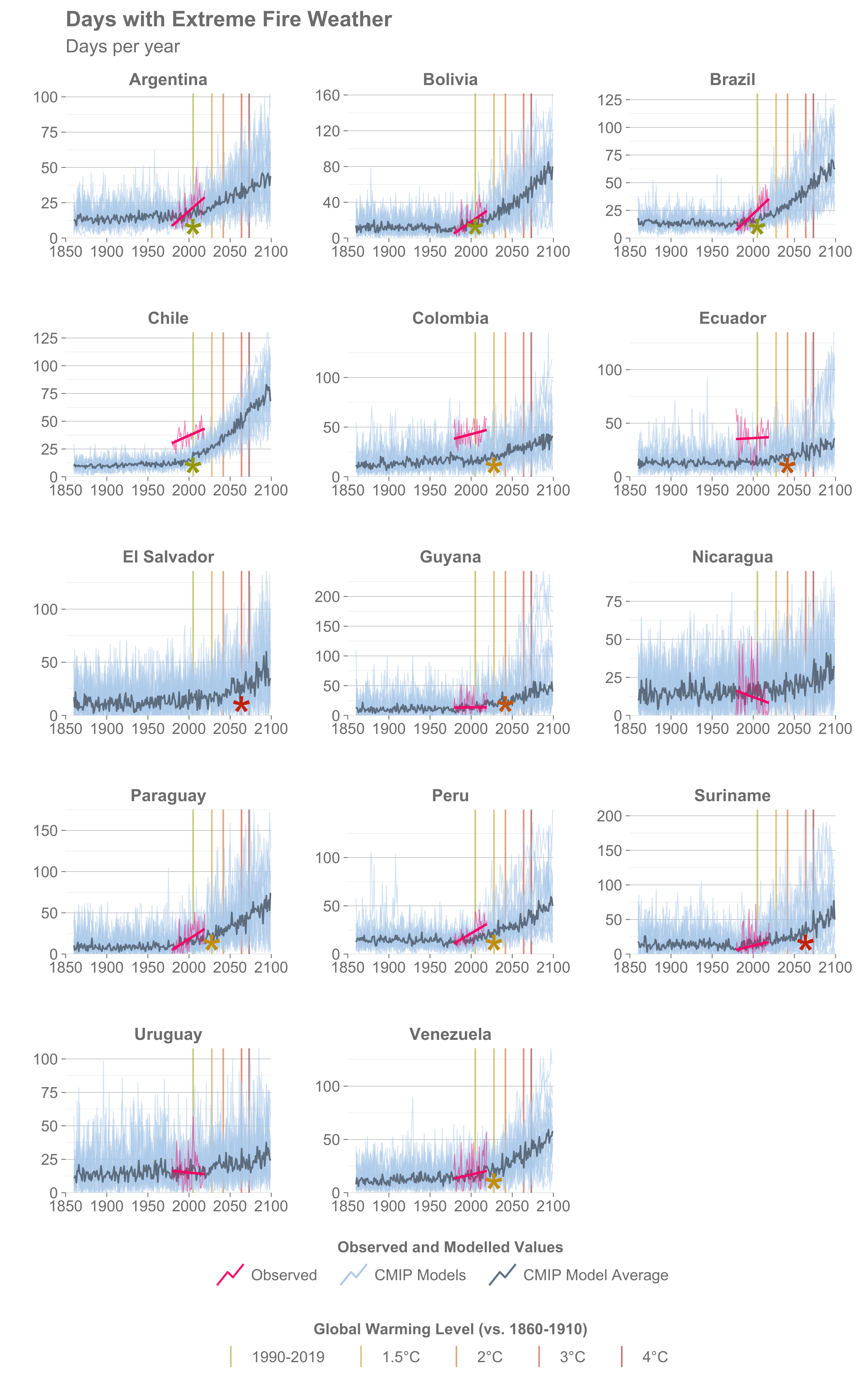
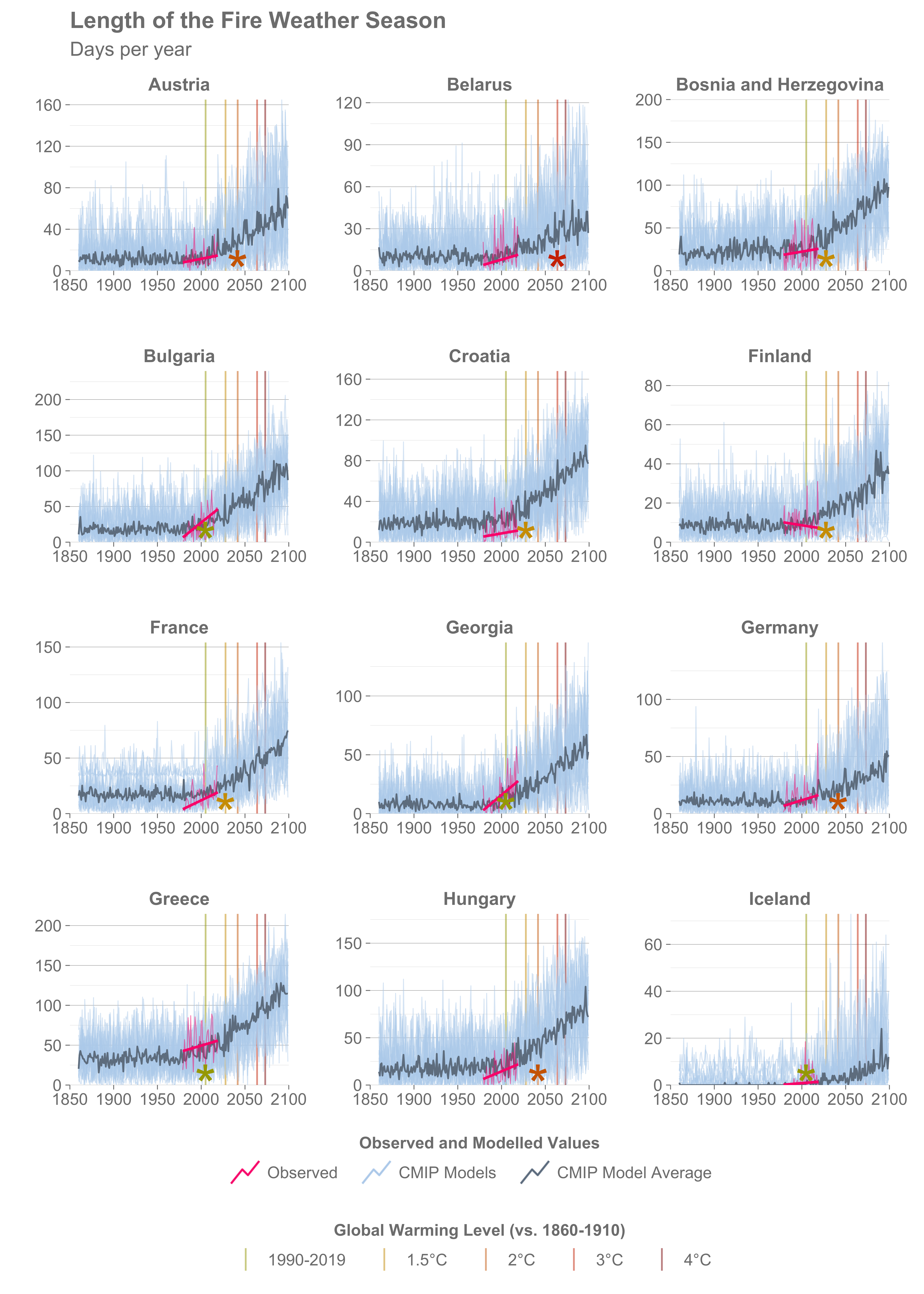
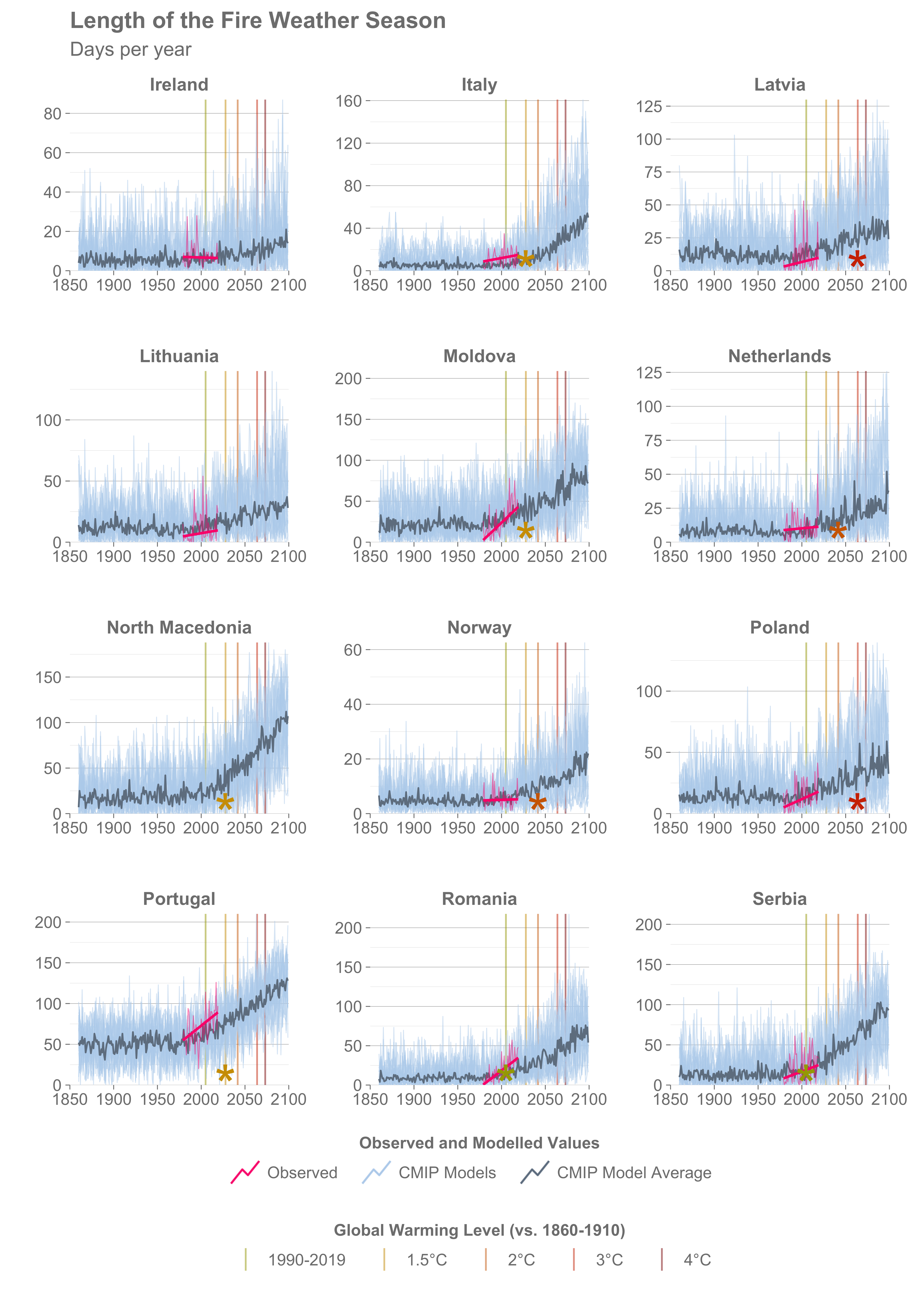
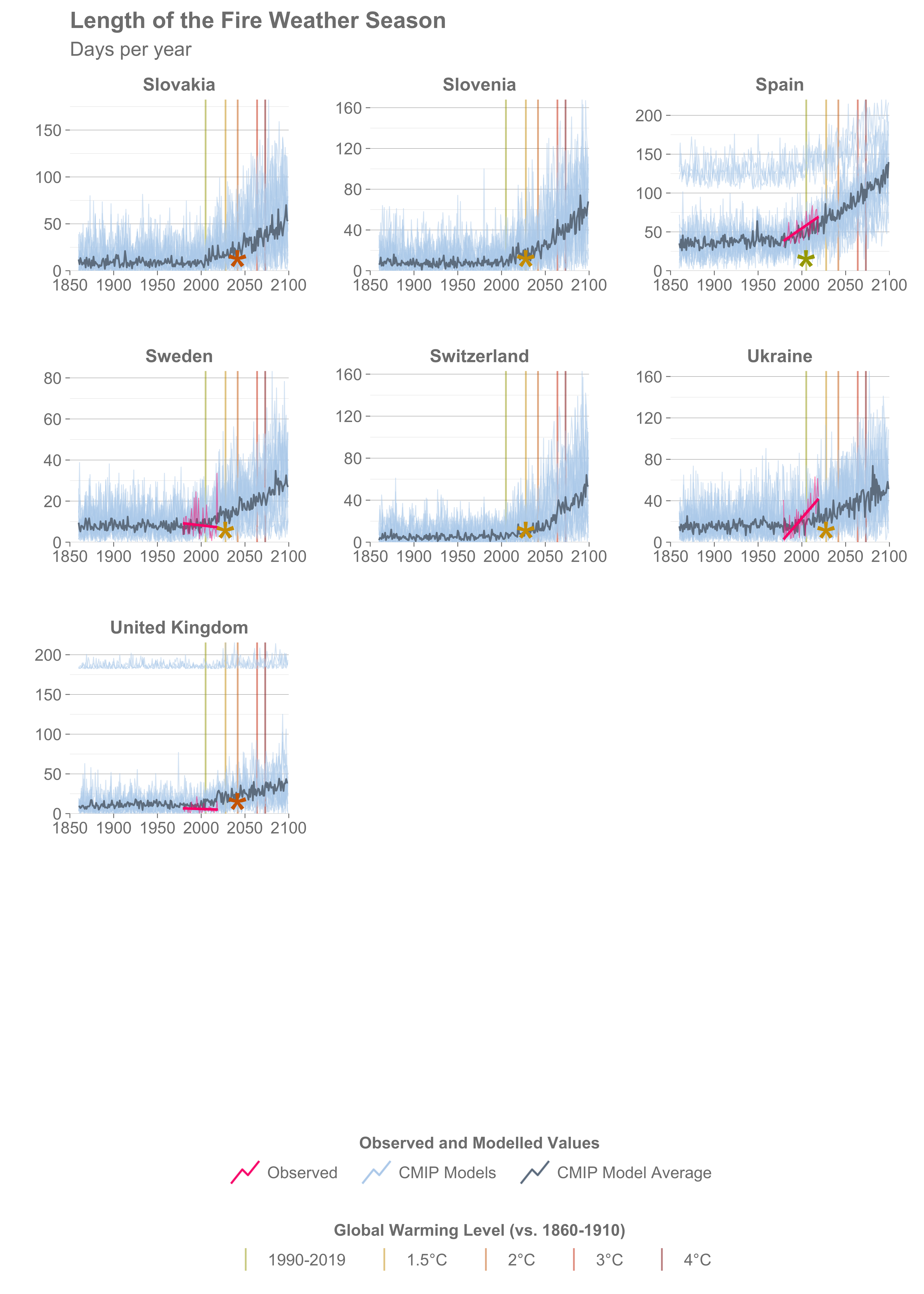
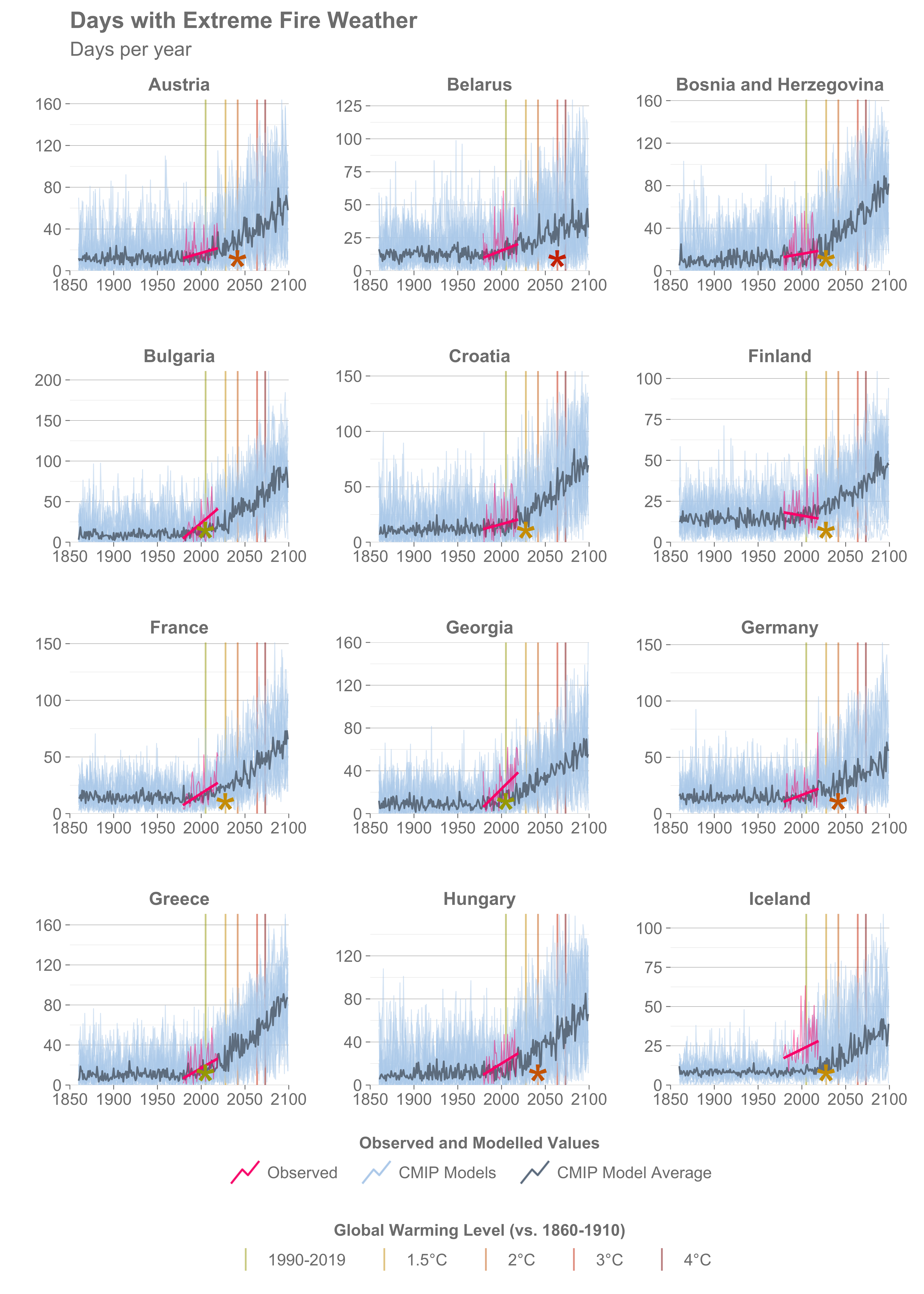
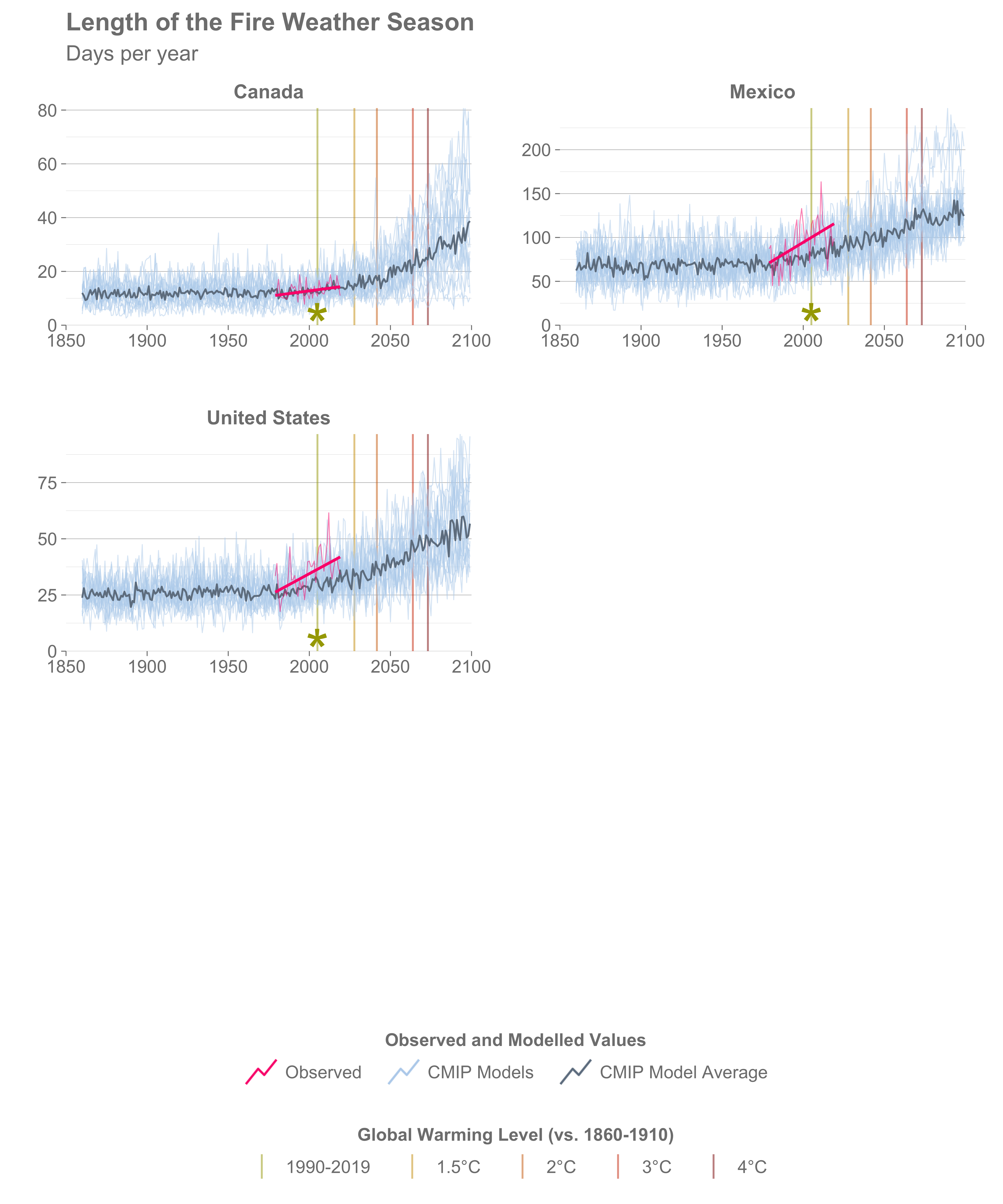
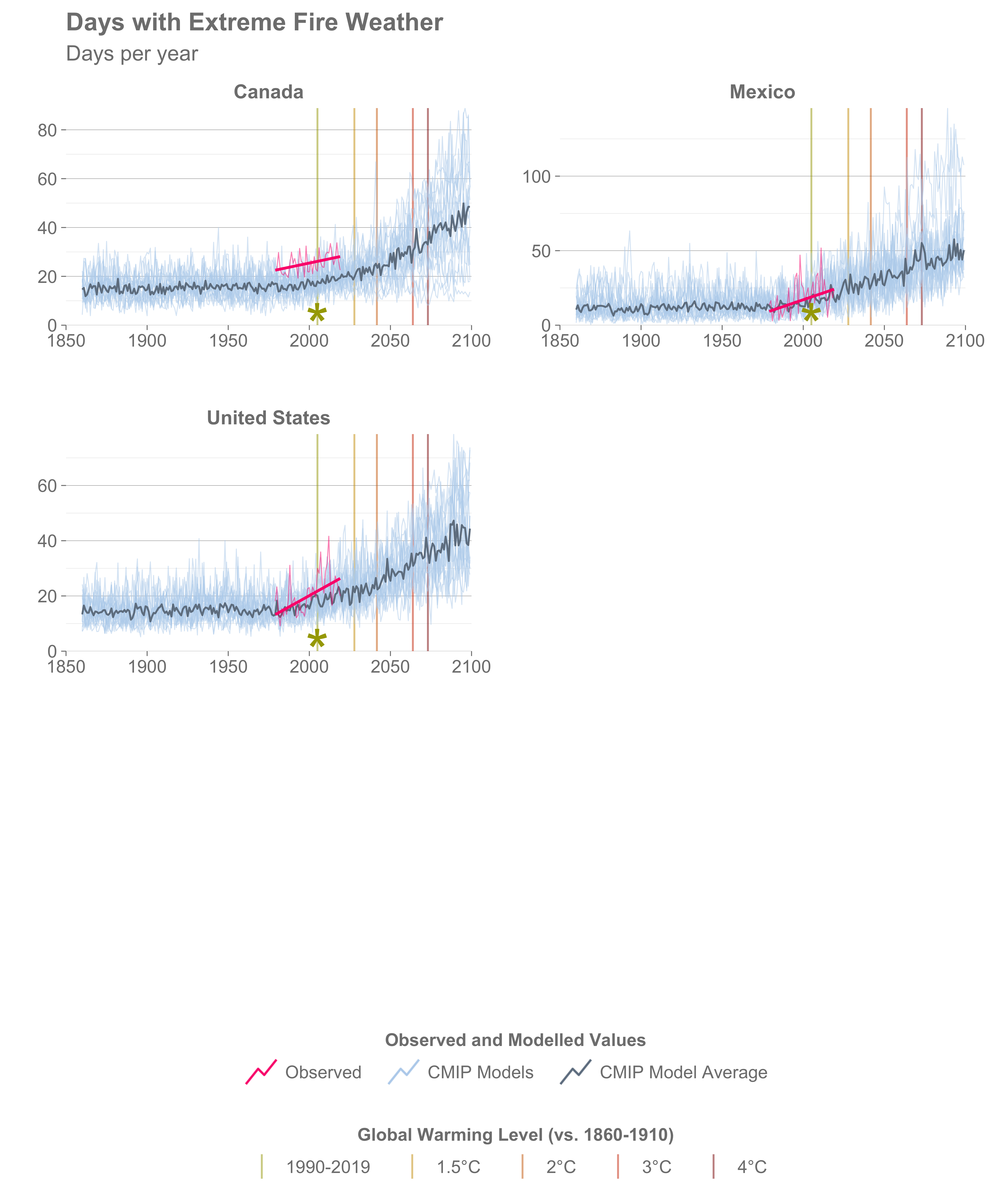
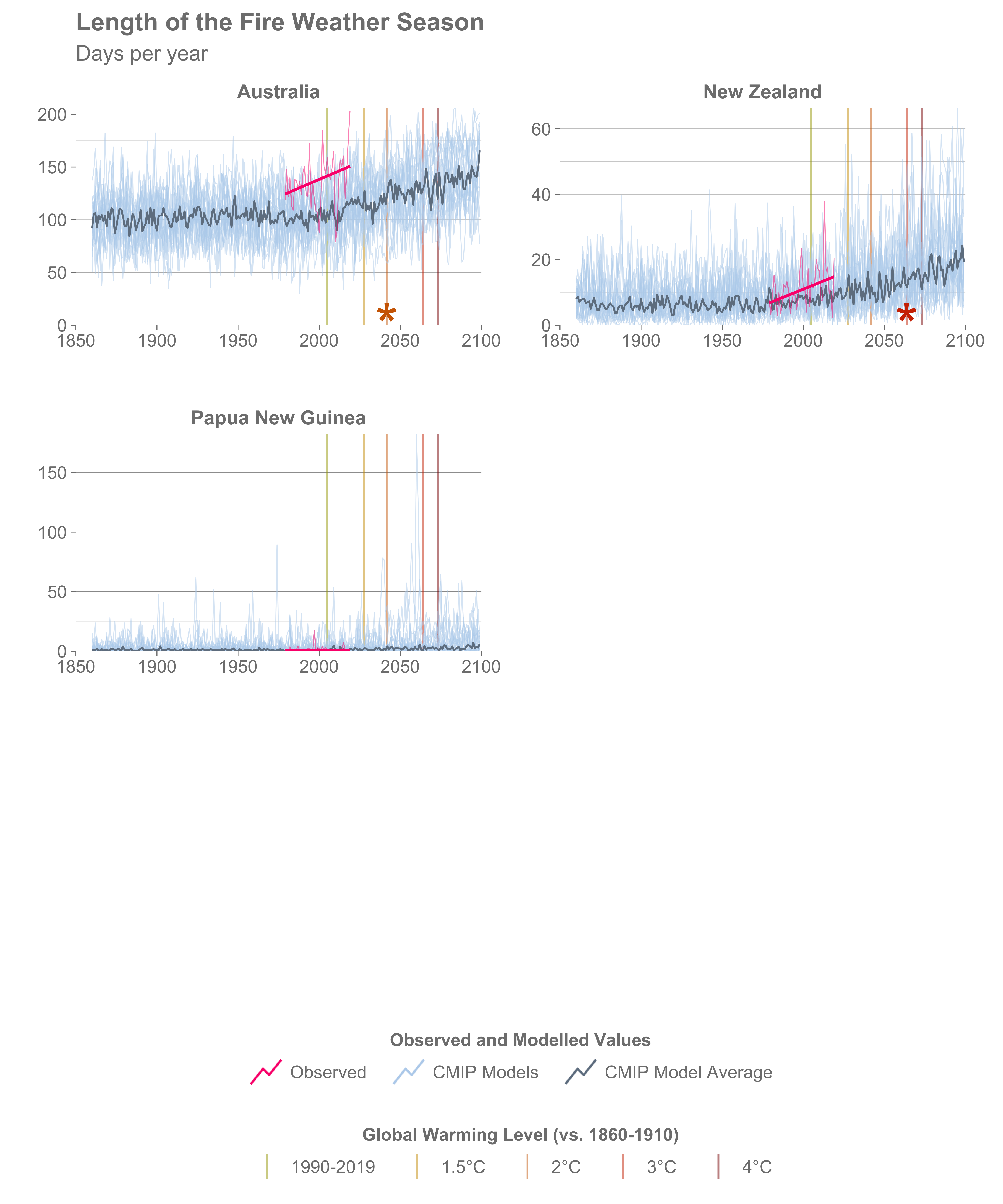
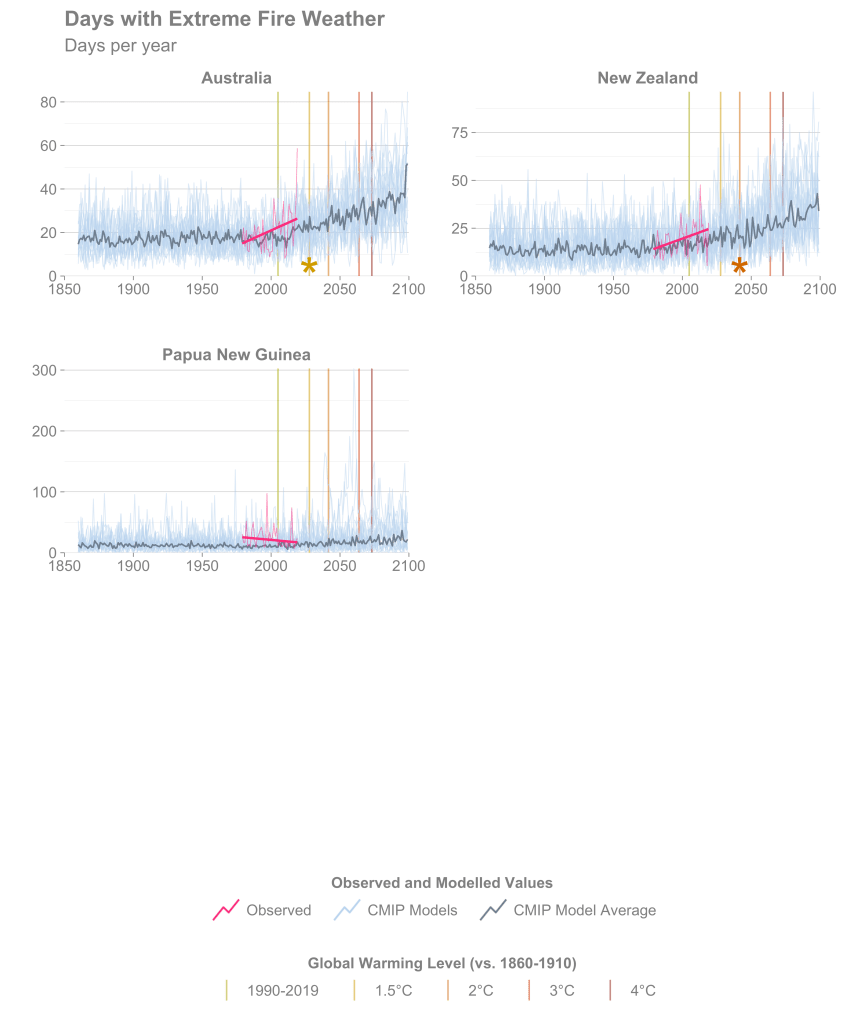
The figures below plot historical and future change in the length of the fire weather season and the frequency of extreme fire weather, based on observations and models.
You can find a technical description of the regional figures and country-level figures in the sections below.
Mapped Changes in Risk

Changes in Risk in Highlighted Regions
Technical bits behind the plots
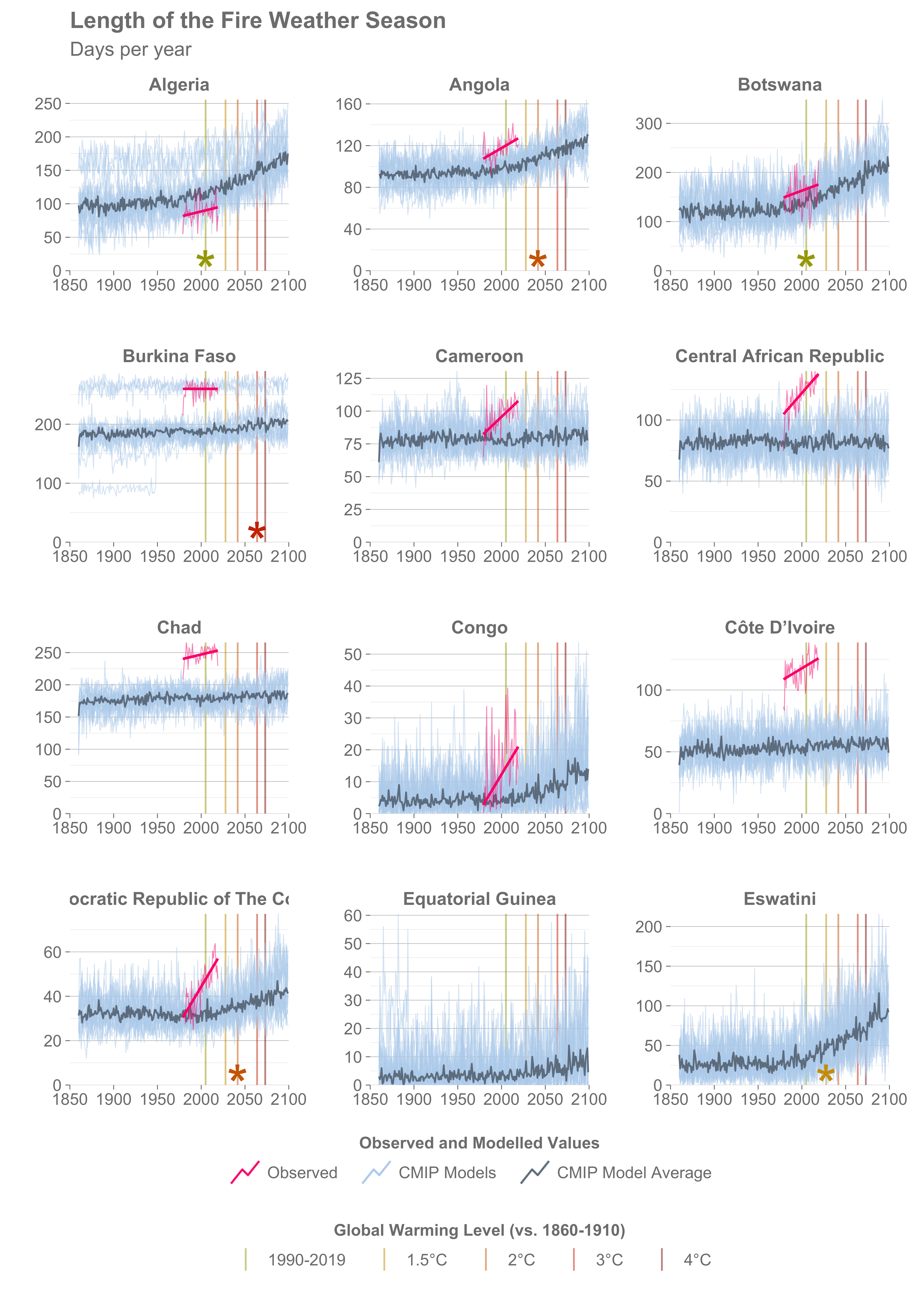
Observed changes in fire weather derive from the ERA5 meteorological reanalysis, which based on observations from weather stations as well as observations of many other variables from satellites and other Earth observations.
The plots also feature estimates of historical and future from 17 CMIP5 climate models, with all results relating to the RCP8.5 scenario – a future pathway of continued high greenhouse gas emissions.
Vertical lines in the plots above mark the model-average year in which temperatures reach 1.5°C, 2.0°C, 3.0°C and 4.0°C above the pre-industrial period in the RCP8.5 scenario.
Asterisks (*) mark the year in which the fire weather metrics emerges beyond the natural variability seen in the pre-industrial period – this is essentially the period in which fire weather becomes unprecedented.
What do we mean by length of the fire weather season and the frequency of extreme fire weather?
First of all, the Canadian fire weather index (FWI) is the basis of both of these metrics. It’s a system for rating the potential for fire under current weather conditions and accounts for the roles of temperature, humidity, recent rainfall and windspeed.
Length of the Fire Weather Season: The annual number of days with weather conditions that have been typical of historical fire seasons in a region. This is specifically the annual number of days on which the Canadian fire weather index (FWI) value exceeds the midpoint range (min + (max-min)/2) of the period 1980-2010.
Frequency of Extreme Fire Weather: The annual number of days with 95th percentile fire weather. This is specifically the annual number of days on which the Canadian fire weather index (FWI) value exceeds the 95th percentile value of the period 1980-2010.
Check out the Situation in Your Region
Plots of changing fire weather are provided in the Country-Level Figures section below. Skip to your region:
Significance
Lead author Dr Matthew Jones, of the Tyndall Centre for Climate Change Research at UEA, said:
“Wildfires can have massive detrimental impacts on society, the economy, human health and livelihoods, biodiversity and carbon storage. These impacts are generally magnified in the case of forest wildfires.
“Clarifying the link between forest wildfire trends and climate change is critical to understanding wildfire threats in future climates. Societies can either push with or pull against the rising risks of fire under of climate change, and regional actions and policies can certainly be important for preventing wildfires or reducing their severity.
“Ultimately, though, we will be fighting the tide of escalating fire risks as the world warms further. Doubling down on efforts to cut greenhouse gas emissions and limiting warming to below 2°C is the most effective thing we can do to avoid the worst risks of wildfire on the global scale.”
Sander Veraverbeke, Associate Professor at VU Amsterdam added:
“A milestone achievement of this mega review is that it provides explanations for the important regional differences in fire trends under climate change. Forests in the mid and high latitudes are particularly sensitive to increasing fire extent and severity under climate change.
“In other regions, the elevated climatic risk for increasing fire is also present, however, fire activity is often heavily influenced by human activity controlling fire ignitions and spread.
“This also shows that there are opportunities to mitigate the negative effects of fires by carefully managing fuels and fires in landscapes.”
The Human Dimension
The authors highlight that humans have important regional effects on wildfire activity in a warming world. For example, they have increased fire ignitions and reduced the natural resilience of some ecosystems to fire, most notably in major tropical deforestation zones of Amazonia and Indonesia.
In contrast, humans have also reduced the spread of wildfire through naturally fire-prone landscapes by converting land to agriculture and fragmenting the natural vegetation, as seen in savannah grasslands in Africa, Brazil and Northern Australia during recent decades.
Co-author Prof. Guido van der Werf, from VU Amsterdam, said:
”Humans have important regional effects on wildfire activity in a warming world. For example, they have increased fire ignitions and reduced the natural resilience of some ecosystems to fire, most notably in major tropical deforestation zones of Amazonia and Indonesia.
“In other places, humans have also reduced the spread of wildfire through naturally fire-prone landscapes by converting land to agriculture and fragmenting the natural vegetation, as seen in savannah grasslands in Africa and South America during recent decades.”
Humans can also reduce unwanted ignitions or use firefighting to suppress wildfires, as historically done in forests of the US, Australia and Mediterranean Europe. However, the authors say this can have unintended consequences in regions where fire is a natural component of the functioning of ecosystems.
For example, policies that aggressively excluded fire from the western US landscape during the 20th Century resulted in forests that are now overburdened with vegetation fuels, contributing to more severe wildfires during recent droughts. The use of low-intensity fires at times with safe weather conditions is increasingly viewed as an important tool for keeping fuels in check while also facilitating natural ecosystem functions.
Co-author Dr Cristina Santín, from Swansea University and the Spanish National Research Council, added:
“Despite the fact that weather conditions promoting wildfire have already increased in nearly in every region the globe and will continue to do so, human factors still mediate or override the climatic ones in many regions.
“We hope this research helps to resolve the entrenched and conflicting views on climate change versus land management being the root cause of these catastrophic fires.”
Some Highlighted Findings
- The length of the annual fire weather season has increased by 14 days per year (27%) during 1979-2019 on average globally and the frequency of days with extreme fire weather has increased by 10 days per year (54%) during 1979-2019 on average globally.
- Fire weather has risen significantly in most world regions since the 1980s. Increases have been particularly pronounced in western North America, Amazonia and the Mediterranean. Fire weather has already emerged beyond its natural variability in the Mediterranean and Amazonia due to historical warming.
- At 2°C this will also be the case in the boreal forests of Siberia, Canada and Alaska and the temperate forests of the western US. At 3°C, virtually all world regions will experience unprecedented fire weather.
- Globally, the area burned by fires has decreased by around one-quarter – or 1.1 million km2 – during 2001-2019. Much of the decrease – 590,000 km2 – has been in African savannahs, where 60-70% of the area burned by fire occurs annually. Local/regional human impacts have reduced the area burned by fire in tropical savannahs, in combination with lower grassland productivity during (increasingly drier) wet seasons.
- Large increases in burned area have been observed elsewhere, and especially in temperate and boreal forests. For example, the area burned by fire has increased by 21,400 km2 (93%) in east Siberian forests and by 3,400 km2 (54%) in the forests of western North America (Pacific Canada and US combined).
Country-Level Figures
Skip to your region:
Download the figures at the link below (media/communicators, please credit the authors and tag @Jones_MattW and @climate_guy)
Download the underlying data at the link below (please cite or credit the authors as appropriate – see data file)
Africa
Fire Weather Season Length
Frequency of Extreme Fire Weather
Asia
Fire Weather Season Length

Frequency of Extreme Fire Weather


Central and South America
Fire Weather Season Length

Frequency of Extreme Fire Weather
Europe
Fire Weather Season Length
Frequency of Extreme Fire Weather

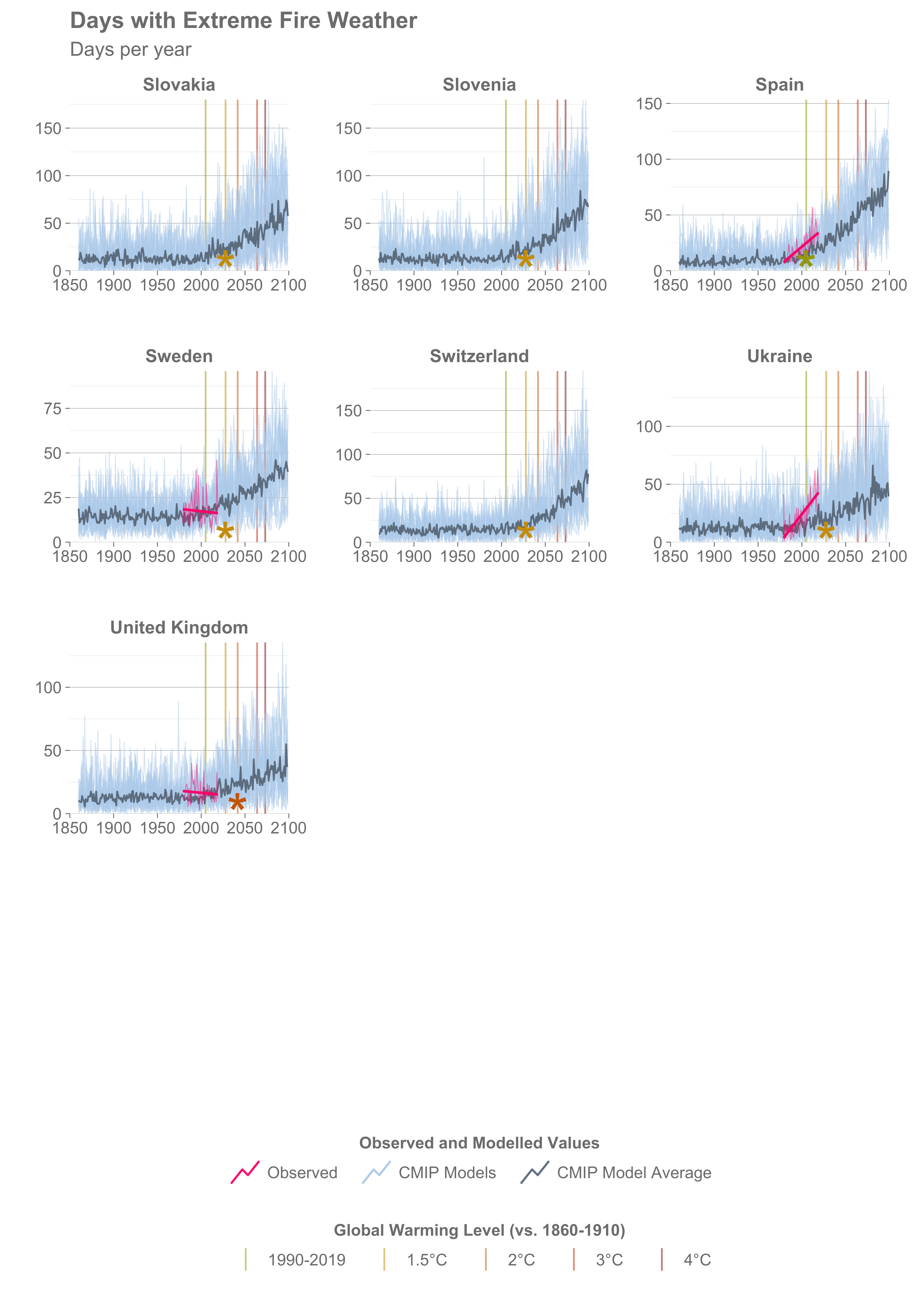
North America
Fire Weather Season Length
Frequency of Extreme Fire Weather
Oceania
Fire Weather Season Length
Frequency of Extreme Fire Weather
 Dr Matthew Jones