National contributions to climate change due to historical emissions of carbon dioxide, methane, and nitrous oxide since 1850
Matthew W. Jones, Glen P. Peters, Thomas Gasser, Robbie M. Andrew, Clemens Schwingshackl, Johannes Gütschow, Richard A. Houghton, Pierre Friedlingstein, Julia Pongratz & Corinne Le Quéré
Read our article in Scientific Data (2023)
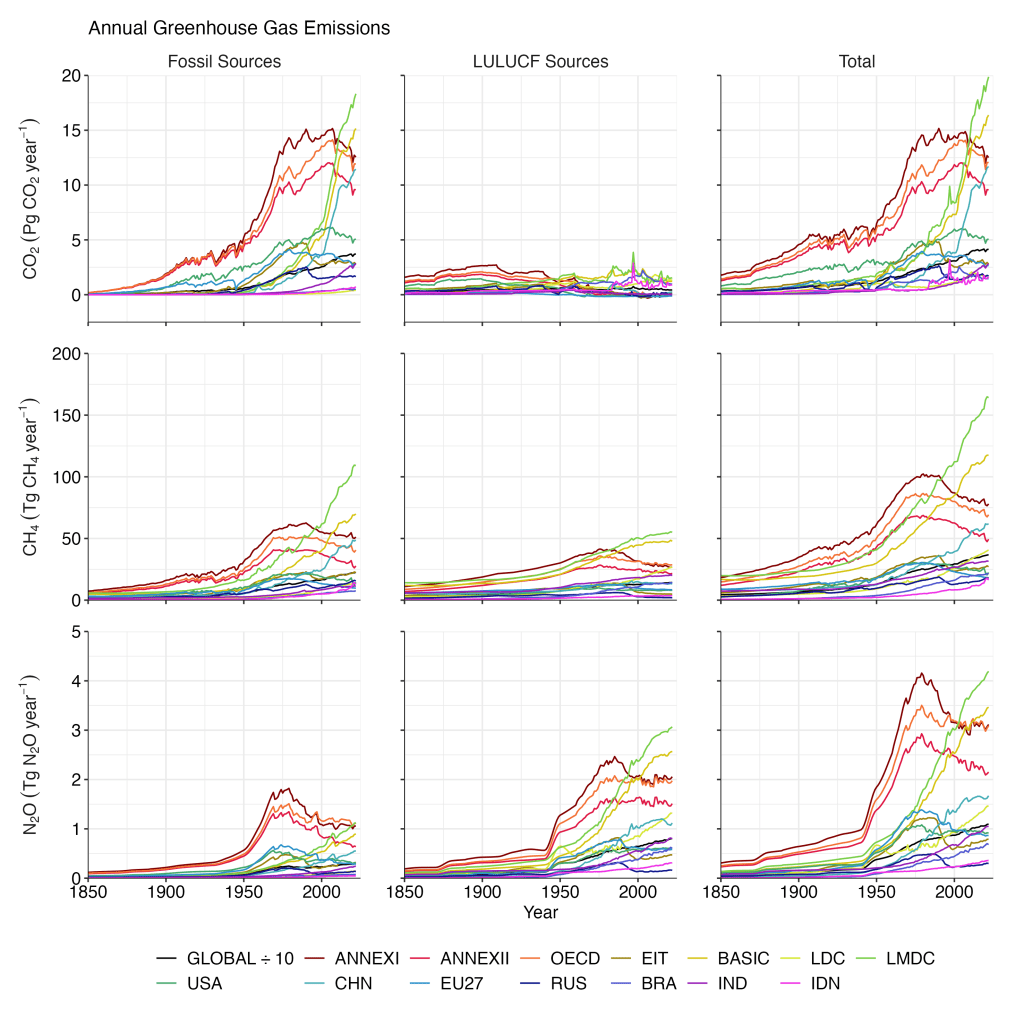
GHG Emissions on the Rise
Large-scale emissions of greenhouse gases (GHGs) from fossil fuel use began in the industrial era and accelerated through time.
Emissions from land use, land use change and forestry (LULUCF) have also risen dramatically during recent centuries.
Using national emissions data from the Global Carbon Project and the PRIMAP-hist dataset, we built a dataset of emissions from fossil fuels and land use change since 1850.
GHGs Accumulating in the Atmosphere
GHGs emitted by people are accumulating in the atmosphere, driving global warming and climate change.
Due to the uptake of GHGs by natural processes such as plant photosynthesis and diffusion in to sea water, not all of the GHG emitted remains in the atmosphere. For example, a relatively constant 50-55% of the CO2 emitted by people remains in the atmosphere.

Impacts on Earth’s Temperature
Equations known as the Transient Climate Response to Cumulative CO2 Emissions (TCRE) have been developed and reviewed by the IPCC for calculating the response of global mean surface temperature to CO2 that is accumulating in the atmosphere.
In addition, equations known as Global Warming Potential (GWP*) have been developed to equate the emissions of non-CO2 gases to equivalent emissions of CO2.
By combining these equations, we equated cumulative national-level emissions of CO2, CH4 and N2O to a global warming response.

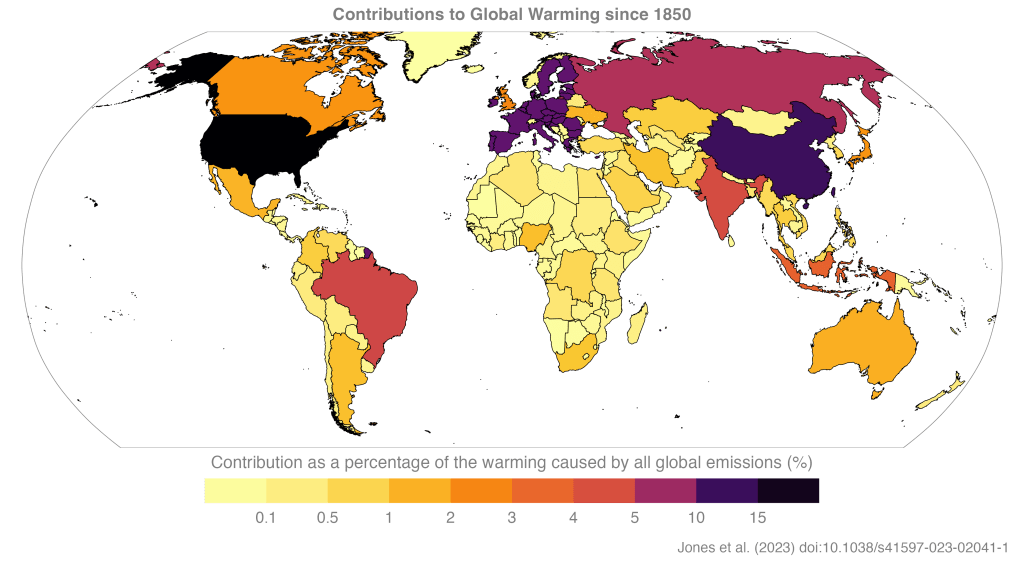
World’s Leading Contributors to Warming
The USA, China, EU27 (grouped in the plot), Russia, Brazil, India and Indonesia are the leading contributors to warming since 1850.
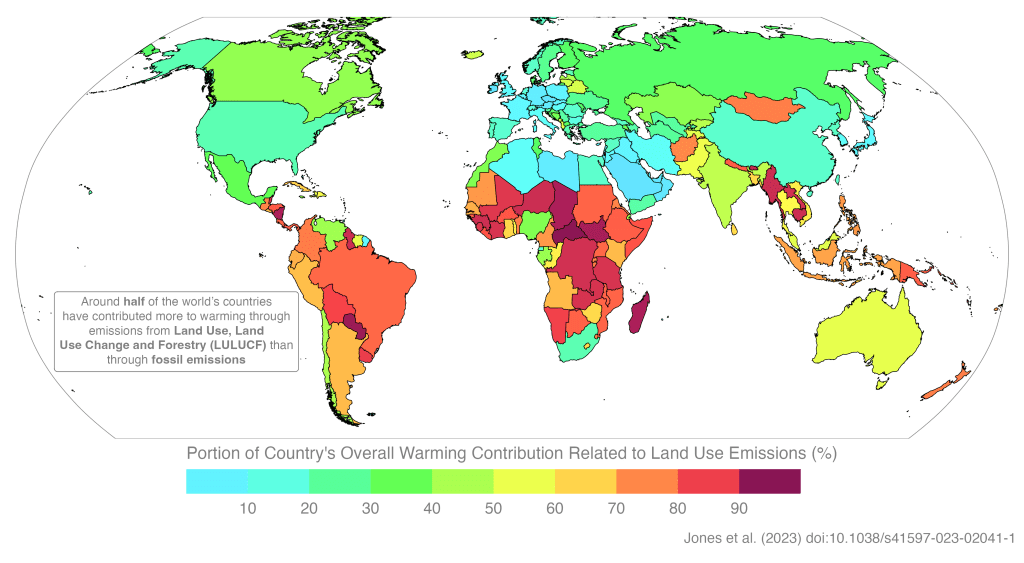
Variability in Warming Contributions from LULUCF and Fossil Fuels
The composition of national contributions to warming varies by country, with some countries (particularly early-industrialisers) contributing more via fossil fuel emissions than via emissions from LULUCF, and the vice versa is true elsewhere (particularly in developing nations).
Change through Time
The different development histories of countries has contributed to shifts in their contributions through time. Notably, the contribution of the most developed countries (e.g. Annex-I parties and OECD members) to warming has been falling amidst a rise in emissions from developing nations.
A key challenge in making estimates of contributions to climate change is the emissions that are embodied in goods and services produced in one country and transported to another. Consumption-based estimates of national contributions to warming may look very different to estimates of territorial contributions to warming, most pointedly in developing countries with large industrial sectors that export to fulfil demand in developed nations.


 Dr Matthew Jones
You must be logged in to post a comment.